Thursday, October 8, 2009

5V -1A Power Supply using LM2575

5V -1A Power Supply using LM2575

A Power Transistor which is having a drop of 4 Volts across it and passing 3 amps thru it, may dissipate around 12 Watts of Heat, This is the problem in Series Regulators. While a Saturated Transistor or Mosfet with 1 Volts across and 3 Amps Thru will be just 3 Watts. But then a fully on transistor or mosfet cannot be controlled or regulated, for that we turn it ON and OFF very fast so that the right amount of current or voltage is delivered.

5V -1A Power Supply using LM2575

The way this is done is PWM - Pulse Width Modulation. In this the mosfet or transistor is switched ON-OFF at say 100 kHz, but the ON duration is varied to control the output. The longer the duration of ON time more energy or punch is transferred. Switching losses will be present depending on how fast the rise and fall times of the pulses are.

The Pulsed AC or Chopped DC can be smoothed to the Average with Inductors and Capacitors. The reactive pulses of the Inductor has to be absorbed by a Schottky Rectifier 1N5817 — 20V-1A fast switching diode with low switching losses.

This circuit is derived from an application note of LM2575, It is a Power Switching Regulator from National Semiconductor The details are here LM2575

An application note by On Semiconductor shows how this chip can be used to generate Negative Voltage Power Supplies from Positive Voltages.

How to test a diode

Diodes are one of the components that can be tested very easily.Ordinary diodes as wells as Zener diodes can be checked by using a multimeter. While testing a diode the forward conducting mode and reverse blocking mode has to be tested separately.

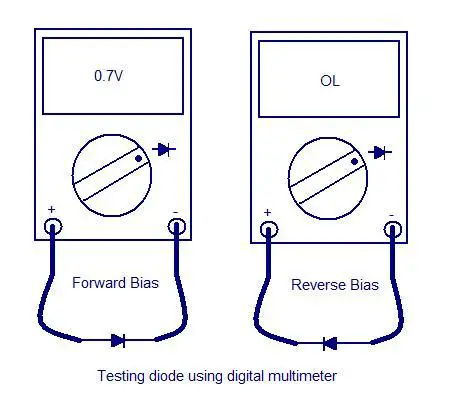
Testing ordinary diode using a digital multimeter.
To check an ordinary silicon diode using a digital multimeter, put the multimeter selector switch in the diode check mode. Connect the positive lead of multimeter to the anode and negative lead to cathode of the diode. If multimeter displays a voltage between 0.6 to 0.7, we can assume that the diode is healthy. This is the test for checking the forward conduction mode of diode. The displayed value is actually the potential barrier of the silicon diode and its value ranges from 0.6 to 0.7 volts depending on the temperature.

Now connect the positive lead of multimeter to the cathode and negative lead to the anode. If the multimeter shows an infinite reading (over range), we can assume that the diode is healthy. This is the test for checking the reverse blocking mode of the diode.

testing-diode-using-digital-multimeter

For testing Germanium diodes, the procedure is same but the display will be between 0.25 to 0.3 V to indicate a healthy condition in the forward biased mode. The potential barrier for Germanium diode is between 0.25 and 0.3V.When reverse biased the multimeter will show an infinite reading (over range) to indicate healthy condition.

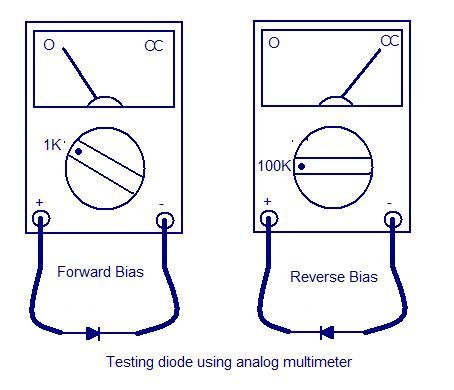
Testing ordinary diode using analog multimeter.
To check an ordinary Silicon diode using an analogue multimeter, put the multimeter selector switch in a low resistance position (say 1K).Connect the positive lead of multimeter to anode of the diode and negative lead of multimeter to cathode of the diode. If meter shows a low resistance reading, we can assume that the diode is healthy. This is the test for checking forward biased mode of the diode.

Now put the multimeter selector switch in a high resistance position (say 100K).Connect the positive lead of multimeter to cathode of the diode and negative lead to anode of the diode. If the meter shows an infinite reading, we can assume that the diode is healthy. This is the test for checking the reverse blocking mode of the diode. The meter shows infinite or very high resistance reading because a reverse biased diode has a very high resistance (usually in the range of hundreds of K Ohms).

testing-diode-using-analog-multimeter


Testing Zener diode.
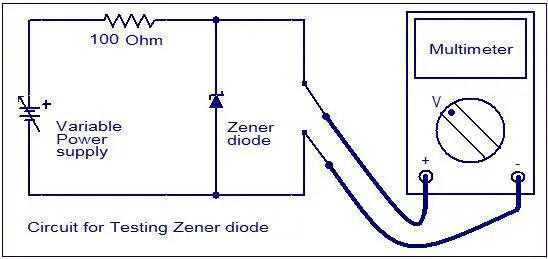
The forward characteristics of a Zener diode is similar to an ordinary diode.So the methods used for testing forward conducting mode of any ordinary diode is applicable to the Zener diode too.But in reverse mode, the reverse breakdown voltage has great significance and it has to be specifically tested.For example a 5.3V Zener diode must start conducting only when the applied reverse voltage just exceeds 5.3V.The reverse bias mode of Zener diode can be easily tested by using the circuit given below.The resistance R1 can be typically 100Ohms.The multimeter must be in voltage mode.Now slowly increase the output of variable power supply and at the same time observe the voltage shown in the multimeter. The multimeter display increases along with the increase in power supply voltage until the breakdown voltage. Beyond that the multimeter reading stays put despite of the power supply voltage. This is because the Zener diode is now in breakdown region and the voltage across it will remain constant irrespective of the increase in supply voltage and this constant voltage will be equal to the breakdown voltage. If the reading of multimeter in this instant is equal to the breakdown voltage specified by the manufacturer, we can assume that the Zener diode is healthy.

circuit-for-testing-zener-diode

While carrying out this test, remember not to exceed the input excitation voltage to a point that forces the Zener diode to dissipate more power than it can safely handle. Typically current through the diode should not be allowed to exceed more than 10mA.

Saturday, October 3, 2009

Car anti theft wireless alarm.


This FM radio-controlled anti- theft alarm can be used with any vehicle having 6- to 12-volt DC supply system. The mini VHF, FM transmitter is fitted in the vehicle at night when it is parked in the car porch or car park. The receiver unit with CXA1019, a single IC-based FM radio module, which is freely available in the market at reasonable rate, is kept inside. Receiver is tuned to the transmitter's frequency. When the transmitter is on and the signals are being received by FM radio receiver, no hissing noise is available at the output of receiver. Thus transistor T2 (BC548) does not conduct. This results in the relay driver transistor T3 getting its forward base bias via 10k resistor R5 and the relay gets energised. When an intruder tries to drive the car and takes it a few metres away from the car porch, the radio link between the car (transmitter) and alarm (receiver) is broken. As a result FM radio module gene-rates hissing noise. Hissing AC signals are coupled to relay switching circ- uit via audio transformer. These AC signals are rectified and filtered by diode D1 and capacitor C8, and the resulting positive DC voltage provides a forward bias to transistor T2. Thus transistor T2 conducts, and it pulls the base of relay driver transistor T3 to ground level. The relay thus gets de-activated and the alarm connected via N/C contacts of relay is switched on. If, by chance, the intruder finds out about the wireless alarm and disconnects the transmitter from battery, still remote alarm remains activated because in the absence of signal, the receiver continues to produce hissing noise at its output. So the burglar alarm is fool-proof and highly reliable.


Friday, October 2, 2009

Open source in consumer electronics: What, why and how

As the primary gateway to voice calls, Internet browsing, audio and video applications, and imaging display, demand for consumer electronics are naturally increasing. Specifically, there is a need for more choices in hardware features, software applications and innovative user interfaces (UI) packaged together in portable devices that are customized in various shapes and colors. To meet this growing demand, consumer electronics manufacturers look to open source software and hardware platforms that allow unbarred innovation. In this article, we'll examine why and how manufacturers engage with the open source community, where open source Linux is and isn't succeeding, and how Texas Instruments Incorporated (TI) is participating in various open source projects and organizations, including Google's Open Handset Alliance (OHA).

The move to open source
The move to open source in consumer electronics is driven by fundamental changes in embedded components such as system-on-chips (SoC), processors and embedded devices, which we'll define here as any programmable electronic other than a personal computer (PC).

One fundamental change, driven mainly by silicon manufacturing and architecture advances, rests in the fact that the performance of embedded devices is within reach of our desktops. This allows embedded devices to run the same or highly similar fundamental operating systems (OS) and graphical user interface (GUI) toolkits as desktops. This has made embedded platforms accessible to large numbers of developers resulting in the boom of embedded software innovations we're beginning to see. Applications that previously were only available on desktops are now smaller and cheaper, and can easily be customized and integrated onto the smaller, embedded devices consumers crave.

While embedded devices are almost starting to look and act like mini PC's, they also leave behind much of the fundamental OSes associated with traditional desktops. With PCs, users expect decades of legacy, proprietary software to work—keeping them locked into the same basic OSes and UIs to access information. In the rapidly-evolving consumer electronics market, however, consumers do not have much, if any, legacy software, and they're continually introduced to new, innovative UIs and ways to personalize their applications, which increases their popularity in the market.

To meet the rising demand for open source software and hardware, vendors often support consumer electronics manufacturers by offering the driver support for open source applications. For instance, several silicon vendors, including TI, offer Linux board support packages (BSP) for embedded devices targeting consumer electronics. These BSPs provide manufacturers the fundamental tools to utilize open source software without being constrained by excessive legacy software, enabling them to pick and choose the building blocks for their solution.

Another fundamental change is the rising complexity in embedded applications. In the past, building an embedded product from the start was easy. Anyone could get a small real-time operating system (RTOS), read a book on how to build up a microscheduling kernel, write the UI code and essentially design the entire platform. However, each of these layers is becoming more complex in today's market, and building a product from concept is simply too expensive. Development teams can buy a solution, but system-level complexity makes this complicated unless they are part of a broader hardware/software ecosystem. This obstacle causes consumer electronic manufacturers to consider open source solutions, where they can mitigate complexity and leverage the work of other contributors.

Where open source is—and isn't— succeeding

Linux
The most successful open source projects are the ones with clear business models that productize the shared investments of the community. Some companies choose to invest considerable expertise to support Linux because the return on investment is clear. In particular, developers enjoy the affordability (royalty free) and a handful of additional benefits. Additionally, Linux is more configurable than commercial OSes. When innovating around Linux's core OS components, such as the UI, peripherals, networking or file systems, Linux has shown impressive flexibility for creating portable media players, set-top boxes, navigation systems and more. In general, Linux is winning the race in which high levels of customization and cost sharing is ideal.

Where Linux is losing is in low-customization areas and in integrated vertical solutions. When integrating proprietary IP with Linux, it can be difficult due to the closed nature of the proprietary IP. Often, legal questions arise as well. For instance, if someone contributes code to the kernel that violates an IP agreement, who's liable? What about digital rights management? However, propriety companies still have the opportunity to participate outside of the kernel through the distribution chain by implementing and gaining control over the growing Linux-based systems.

Currently, most Linux development is centered on enterprise applications where hardware companies participate in order to share the software investment required to support the latest server platforms. Embedded activity is also picking up rapidly, and not just in mobile handsets.

For some customers, open source is a solution to rapidly integrate new functionality into products and enable innovation at all layers of their software design, without breaking the bank. If a hardware system has at least 32 megabytes (MB) or more on-board random access memory, the development platforms will typically ship with Linux and with system support.

For example, TI supports Linux on select OMAP processors and digital media processors based on DaVinci technology. TI's OMAP 3 applications processors target a wide range of handsets, Smartphones, mobile Internet devices and other portable electronics with advanced intuitive UIs and features, while processors based on TI's DaVinci technology target digital video-oriented electronics. The OMAP3525 and OMAP3530 processors even integrate a power-optimized version of TI's imaging, video and audio accelerator used in TI's DaVinci technology for advanced video streaming and display.

Figure 1 below shows a development board for the OMAP35x processor supporting open source Linux and will support Windows Embedded CE 6.0 in the future. Originally, TI supported Linux only through commercial distributions, such as MontaVista Linux. In response to growing customer demand for more flexibility, however, TI increased its support for community-based offerings by contributing driver-level support for TI devices in the Linux kernel.


Figure 1. TI's OMAP35x evaluation module (EVM) features support for an open source Linux BSP (based on kernel 2.6.22).

TI is also engaged with a number of organizations promoting Linux, including the LiMo Foundation, Linux Foundation, Consumer Electronics (CE) Linux Forum, and Google's OHA. Short, high-level summaries of the organizations are noted in Figure 2. For more info on TI's participation within Linux and open source visit: opensource.ti.com.


Figure 2. Short, high-level summaries of the Linux organizations TI is a member of.


Google's OHA
In November 2007, Google announced its Android platform, an open source mobile platform based on Linux. In conjunction with the Android launch, Google also announced the OHA, a coalition of handset manufacturers, silicon vendors, wireless carriers, and application developers aiming to build phones and applications around Android. TI is a founding member of the alliance.

By providing an open alternative to the closed platforms most wireless carriers offer, Google and its partners hope to spur innovation and deliver a better mobile web experience than closed platforms enable. Android-based handsets are starting to hit the shelves and make their way into consumer's hands: HTC recently developed the first Android-based phone, the G1, which is available in limited quantities today and expected to reach wide availability by the end of October on the T-Mobile network.

TI is a strong supporter of Android. TI initially announced working with Google in 2007, supporting the OHA and Android platform with TI's OMAP processors, and Bluetooth and WLAN mobile connectivity technologies. At Mobile World Congress 2008, TI demonstrated the very first Android prototype phone, and other Android-based advancements. The demonstrations at the event showcased an Android prototype phone using an OMAP850 applications processor, which integrates applications and baseband on the same chip, and an Android-based development board running on the OMAP3430 processor-based Zoom Mobile Development Kit (MDK).

Bridging the development gap, Android is succeeding with phone makers, silicon vendors, and wireless carriers working together to design a large variety of Android OS-based devices. This enables applications developers to write software for a much wider range of phones, thereby making their efforts more lucrative. Additionally, the rich software ecosystem gives consumers more choices in hardware features, form factors, and UIs. In turn, people buy more phones, download more applications and subscribe to more services. Everyone wins.

What about the PC?
Who needs open source electronics when we have PCs? In the traditional view of convergence, as illustrated in Figure 3, the PC combines all of our embedded devices.


Figure 3. Traditional view of convergence.

With recent market trends, it's evident that convergence will more likely evolve within consumer electronics, rather than repurposed PCs. With "on-the-go" capabilities, consumer electronics are better to integrate critical PC functionality into our daily devices. They tend to be cheaper, quieter, more power efficient, and more importantly, built for multimedia. They also cut through the fluff and get right to what consumers want. These converged consumer electronics devices are already starting to enter the market. In fact, recently released by ARCHOS is an Internet media tablet based on an OMAP 3 application processor that converges a MP3 player, a video player and a general computing platform into one device.

TI: Committed to open source
TI engineers regularly use open source tools in chips design, software development and IT infrastructure activities, and are encouraged to support and give back to open source communities that spur innovation. Giving back to the open source community opens new relationships and communication that leads to increased knowledge and more opportunities. Most importantly, open source engagements help TI meet customers' requirements even more efficiently.

For instance, a small group of enthusiastic engineers interested in creating powerful, open and embedded devices worked together on the concept and realization of the Beagle Board. The resulting 3 inch by 3 inch board bridges desktop and embedded development by allowing developers to use the same peripherals and usage mode for flexible USB and standard PC expansion. Enabled with a full computer in their hands, developers are able to design to their specification on the OMAP3530 processor and to collaborate with the open source community on creative new applications at beagleboard.org.

Notable examples of TI contributions include: Joe Ramsey's contributions to RCS, EMACs, NNTP readers/servers, squid, and others; Grahm Barr's contributions to various aspects of Perl; Ryan Eatmon's contributions to Jabber; Rob Clark, Lee Eakin, Denys Dmytriyenko, and others contributions to GStreamer, Perl, Eclipse, and MythTV.

Conclusion
As consumers get a preview for what tomorrow's consumer electronic devices will deliver, suppliers are tasked with creating converged devices that loop in additional choices and functions. Yesterday's devices just won't do, and the open source initiatives promise to help bring the latest and greatest products that drive the myriad of choices on consumer wish lists.

Although open source development faces certain hurdles, the growing number of companies, including TI, supporting open source activities sees the value in meeting these demands. Additionally, the support among hardware vendors for open source creates a rich ecosystem that gives device makers more hardware feature options.

Overall, open source advancements mitigate the rising complexity in embedded designs, and also eliminate licensing fees to drive down the overall cost and create rich software ecosystems for customized functions. By converging devices and adding extra features, open source extends products' usefulness and satisfies consumers' demand. That's the full beauty of open source.

About the author
Jason Kridner is the open platforms principal architect for Texas Instruments' DSP Systems Catalog Processors. As a champion of open source and open standards, Kridner is excited about a future where consumers' often specialized customization needs are met far beyond selecting wall-paper and keyboard shortcuts. Frustrated by the limited reach of computers and other helpful electronic products to consumers, Kridner is passionate about pervasive and accessible computing platforms.

Kridner graduated from Texas A&M with a bachelor's in Electrical Engineering and was drawn by the allure of digital signal processing to Texas Instruments in 1992. He began to establish himself as a hardware developer, working on board, FPGA, and ASIC designs. Utilizing software experience prior to TI, Kridner transitioned to lead software development of low-power media software, audio processing, file systems, USB drivers, digital rights management, and video codecs .


Environmentally friendly protection of automotive electronics

Famous golfers are not the only ones who can wear a prized green coat. How about your automotive electronics? Are they wearing green?

Many of today's automotive circuit boards are benefited from the use of conformal coatings that allow them to reliably operate in rather harsh underhood environments. Conformal coatings have proven track records of protecting boards from dust and debris, liquids, and from contact with a wide gambit of harsh conditions thrown against them. Protective coatings work by forming a barrier to conductive contaminants that closely conforms over surfaces, components, wire bonds and solder joints. Additionally they electrically insulate and isolate conductors which may be in close proximity. Several studies have shown that silicones have been one of the best conformal coatings at slowing the formation and growth of these tin-whisker species. Additionally they may also deflect the growth direction which can prolong the expected life expectancy of the electronic assembly.

It is easy to concentrate on the price per kg when considering various types of coatings, but it is only part of the total cost of ownership. Likewise, materials which require a cure oven not only add capital costs when setting up a production line, but also incur energy costs to run. Other costs can include the cost of quality such as measured by first time reject and rework rates. Besides cost of ownership, performance criteria certainly must be met in automotive electronics.

Electronics vendors pursue autos as new horizon

LAS VEGAS — In a concerted effort to loosen the economic logjam that has stifled industry growth during the past year, electronics makers and software vendors at the 2002 International Consumer Electronics Show (CES) this week set their sights on a new target: the largely untapped vehicle telematics and multimedia markets.

Makers of satellite radio systems, digital video disk players (DVDs), rear-seat videos, navigation systems and wireless transceivers stepped up their efforts in the automotive arena, in hopes of staking out their territory inside cars and trucks. They were joined by such longtime automotive vendors as Visteon Corp. (Dearborn, Mich.) and Delphi Automotive Systems (Troy, Mich.), which showcased more of their best technologies at CES, rather than at annual auto shows in Detroit and Los Angeles, also held this week.

The emphasis on automotive electronics could signal the beginning of a new era for both the electronics and automotive industries. Industry analysts said that electronics manufacturers and chip makers see automotive as an untapped frontier. Unlike users in the home and business markets, they said, most automotive customers have yet to incorporate electronic gadgetry.

"Companies such as Intel, Hewlett-Packard, Sun and Microsoft are betting on the market potential of the vehicle," noted Thilo Koslowski, lead automotive analyst and market director for Gartner Dataquest (San Jose, Calif.). "They see it as the one big market that has not yet been bombarded by PDAs, cell phones and video."

Automakers, too, see the telematics trend as a potential gold mine. Some believe it will blossom into a $10 billion to $20 billion market in the next four years, with virtually every car being equipped with a cell phone and many using in-car information and navigation services.

"The growth will be tremendous," said Geoffrey Smith, a product specialist for Mercedes-Benz's Telematics Client Assistance Center (Montvale, N.J.).

Mercedes-Benz backed that belief with a huge presence at CES, even cordoning off a parking lot near the Las Vegas Convention Center to allow show attendees to test-drive the company's newest luxury vehicles.

Industry analysts and vendors at this year's CES agreed that the growing automotive presence is providing a shot in the arm for a struggling electronics sector. "It used to be that the automotive world was known as a boom-or-bust market," noted Robert Schumacher, general director of mobile multimedia for Delphi Automotive Systems. "Now, we're the ones bringing the stability here."

Not just teenagers

Such efforts contrast sharply with those of a few years ago. At past Consumer Electronics Shows, automotive displays consisted largely of booming audio systems, many of which were designed exclusively for teenagers. With the advent of in-car multimedia and telematics, however, the 300 or so exhibitors in the show's automotive pavilion geared their products to a broader audience.

Companies such as Pioneer Electronics USA Inc., whose automotive bread and butter was once almost exclusively car audio, displayed an automotive DVD-navigation system. The company also unveiled an AM/FM/CD system with a built-in 10-Gbyte hard drive.

Similarly, Robert Bosch Corp.'s Blaupunkt car audio group rolled out systems for multimedia, navigation and in-car video.

Even the entertainment systems have taken on a decidedly non-teen flavor. The two satellite radio giants, Sirius Satellite Radio and XM Satellite Radio, vied for attention with mammoth show booths that included live entertainment and radio broadcasts.

The Consumer Electronics Association, which runs CES, said that the move toward navigation and video systems is currently the strongest new area in automotive electronics. Association representatives noted that five years ago in-car video and navigation was a market that was too small to track. Now it's hitting $900 million per year.

"In-car electronics is not just for teenagers anymore," said Lisa Fasold, director of communications for the Consumer Electronics Association. "Now it's marketed at moms and dads, grandmas and business customers."

Indeed, many in the industry hope that business customers will become mainstay, basing their hopes on the recent growth of the telematics market, which is expected to jump from $1.3 billion in 2001 to $2 billion in 2002, an increase of more than 50 percent.

Some automakers believe the market could reach $20 billion annually. A study by Forrester Research (Cambridge, Mass.), however, puts the figure closer to $6 billion. Either way, many electronics and software makers believe that the automotive telematics field holds more potential for growth than any other electronics sector.

"People have huge, huge hopes for telematics," said Dan Garretson, a senior analyst for Forrester Research. "A lot of companies are trying very hard to ride this wave."

Backseat video

Many believe that telematics is so strong that it ultimately could become the tail that wags the automotive dog, with customers trading in their old vehicles in order to buy a new, telematics-equipped model.

That's why such companies as Delphi Automotive Systems and Visteon saved their greatest thunder for CES, even while the worldwide auto market descended on Detroit for the International Auto Show. At CES, they could preach to electronics-savvy attendees, in addition to dealing with customers such as Ford, GM, Honda and Toyota, as well as such chip suppliers as Intel and Texas Instruments.

"Three years ago, Visteon and Delphi were selling directly to Detroit," said Fasold of the Consumer Electronics Association. "Now they're showcasing their technology here."

Indeed, Delphi rolled out 12 new automotive products and nine new technologies in 11 vehicles on the show floor. Those included a first-ever demonstration of a system that would enable home users to upload and download movies and audio files from home to car using 802.11a wireless technology. Shown on a General Motors Montana minivan, the system uploaded video files at speeds approaching 54 Mbits/second.

For the design of the system, Delphi teamed with Intel Corp., which provided the 802.11 wireless hardware, including an Intel PRO/Wireless 5000 LAN Card Bus Adapter in the vehicle, and PRO/Wireless 5000 LAN access points outside the vehicle. The Intel products operate in the 5-GHz frequency band and are based on the 802.11a standard. Delphi engineers said that, using the system, an MPEG-4-compressed file could typically be downloaded to the vehicle in four to five minutes.

Automakers and vendors hope that such technology will set the stage for gas stations and convenience stores to install kiosks where customers could download music and movie files for play on their rear-seat audio and video systems. The speed of the 802.11a systems makes the idea feasible, they say, because they are approximately 1,000 times faster than cell phone data rates.

For business users, Delphi engineers also teamed with counterparts from MobileAria (Mountain View, Calif.) to demonstrate hands-free Internet capabilities inside a new Saturn VUE sport utility vehicle. Using a MobileAria True Hands Free server, a Delphi Communiport Mobile Productivity Center, a GPS receiver and a Bluetooth-enabled laptop computer, engineers showed how the system could retrieve e-mail and Internet content while the driver watches the road, then read it back to the driver using a text-to-speech engine. As a result, the system enables drivers not only to download Web-based news, but also to some day retrieve up-to-the-second, accurate, Internet-based traffic reports.

Similarly, Visteon displayed a receiver that broadcast content from Sirius Satellite Radio.

The conveniences of home

Automakers see the implementation of such technology as a critical step in building customer affinity. At the show, Mercedes-Benz allowed attendees to test-drive electronics-equipped vehicles ranging from the company's $26,000 C-class sports coupe to the $130,000 CL-600 sedan. They used data capture units to capture names of attendees and built a bond with those who see electronic technology as a critical part of the driving experience.

"These people see their cars as extensions of their homes," noted Michael Smith, national manager for Presence Marketing for Mercedes-Benz. "And they want to put a lot of the conveniences of their homes into their vehicles."

Mercedes-Benz, which has taken the lead in marketing to attendees of shows such as Comdex and CES, believes it has found a critical new marketing approach. During the past two and a half years, the company has boosted sales of its Tele Aid telematics units from zero to 300,000, and has moved from U.S. sales of 60,000 vehicles per year to 206,000 last year.

Analysts believe that the current telematics fever is a double-edged sword of sorts, breathing new life into the electronics industry while simultaneously taking down scores of startup companies in the process.

"This is good for the consumer electronics industry," said Koslowski of Gartner Dataquest. "The consumer home market is approaching some level of saturation, and the business market is still suffering from a poor economy. The vehicle is the only outpost left that's not approaching saturation."

Still, Koslowski said, it may be too much, too soon. "The auto industry will have to come up with some very innovative applications to reach the potential they're describing," he said. "Right now, the price points are too high and many consumers aren't willing to pay for the kinds of conveniences they're talking about."